
A family we spoke with last year picked a well-reviewed facility on the southern edge of the city for their father’s post-stroke recovery. Newer equipment, better ratings than anything nearby, a physiotherapy team with genuine credentials. After six weeks dropped into four then to one only. Salt Lake city is so far, that if leaving it by 6 pm don’t assure you to reach within the visiting hour. So the visit is much quicker than the one hour which used to be. They moved him. The care at the new place wasn’t better on paper. It was reachable, and reachable turned out to matter more than the brochure did.
That’s the pattern behind most of the comparisons families bring us. Two facilities, similar staff ratios, similar rates, similar equipment listed on the website. What actually decides it, almost every time, is a question nobody puts on a checklist: can someone get there on a Tuesday evening without losing two hours to CIT Road traffic. Ask ten families who’ve been through this decision and most will tell you the same thing in different words — the facility with slightly less polish, but a fifteen-minute commute, won out over the one with better marketing and a ninety-minute drive.
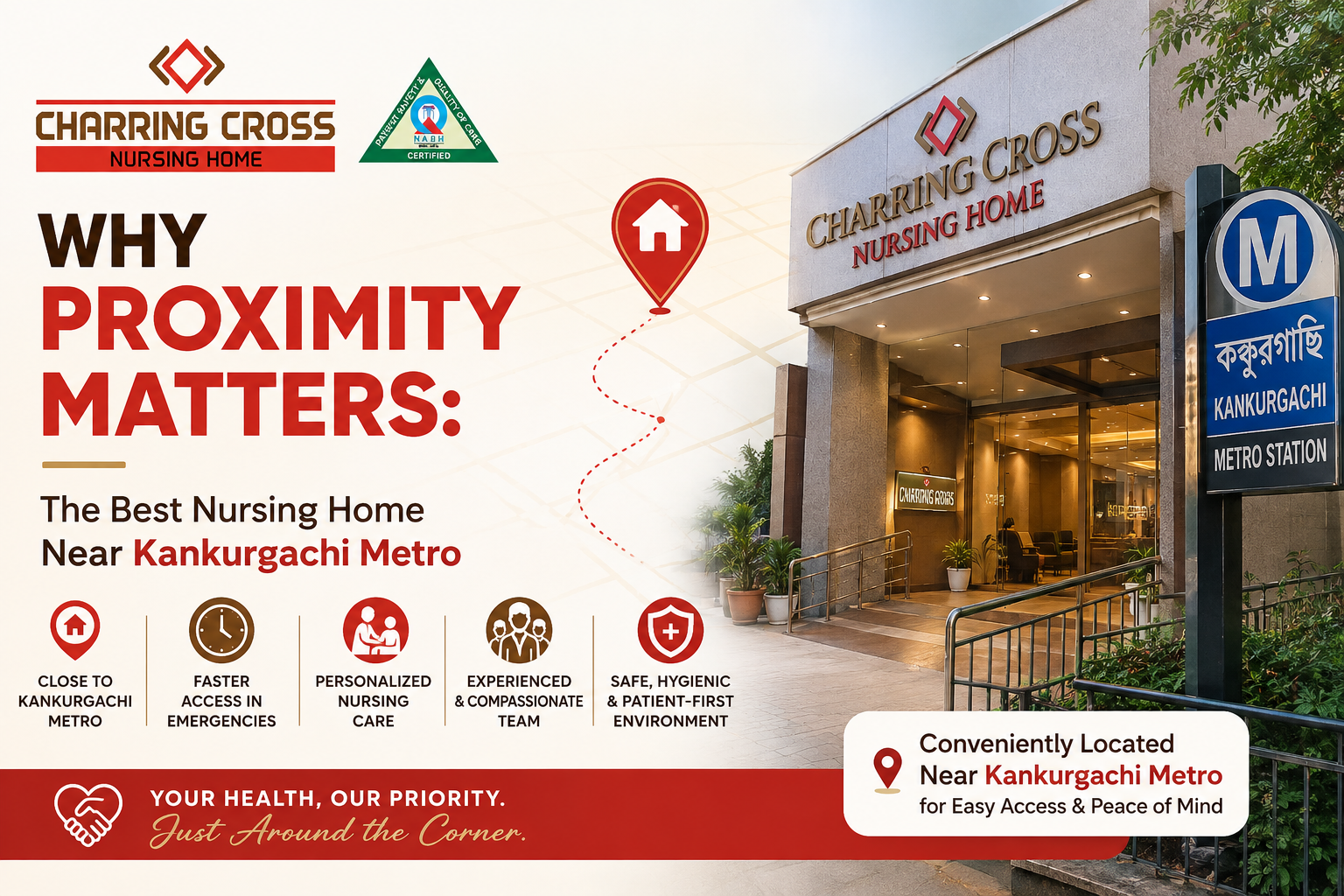
It’s why the best nursing home near Kankurgachi Metro keeps showing up in searches from Maniktala, Phoolbagan, Ultadanga, and the Salt Lake belt. Not because Kankurgachi is inherently superior — it isn’t, and no single neighbourhood is, whatever its local hospitals claim — but because for that specific stretch of North Kolkata, it cuts the travel time that decides whether visiting happens at all. A facility can be excellent and still fail a family, simply by being in the wrong part of the city for the people who need to reach it.
The Numbers Behind Why This Keeps Getting Harder
This isn’t a Kolkata-specific anxiety. It’s a structural shift playing out across urban India, and the scale of it is worth sitting with for a moment.
India’s population aged 60 and above is on track to hit roughly 173 million this year, a figure climbing steadily for over a decade with no sign of flattening (source: HealthOK Global). CARE Ratings’ 2026 sector analysis puts the old-age dependency ratio at 15.7% in 2021, rising to a projected 22.5% by 2036 (source: CARE Ratings). Run the math and the number of working-age adults per elderly dependent shrinks by roughly a third in fifteen years — which means the sibling, spouse, or child who used to share caregiving duties with two or three others is now doing it closer to alone.
Kolkata’s Salt Lake office towers and New Town IT parks are full of exactly the people this affects: adults managing an ageing parent from a different part of the city, not a shared roof. A generation ago, in much of North Kolkata, three generations under one address was the default, and elder care was something that happened by proximity rather than by decision. That’s no longer how most households here are built.
The 60-plus population is expanding at close to twice the rate of the general population, driven by longer life expectancy and shrinking family sizes (source: Senior Care Joy). More elderly relatives, fewer siblings to split the load, and those siblings often working across town from the parent they’re caring for. Industry analysis of India’s geriatric care market shows in-home and near-home care models projected to hold the largest share of that market going forward, ahead of hospital-style institutional care sitting at a distance from where families actually live (source: Coherent Market Insights).
A facility ninety minutes from where the family lives and works gets under-visited, whatever its medical care looks like. Distance doesn’t just inconvenience the family — it sets how often the resident sees someone they know, and that single variable shapes almost everything else about how the stay goes.
What Kankurgachi Actually Offers
For people who don’t have the clear idea, Kankurgachi lies in the borders of Beleghata and Maniktala, a kilometre from Bidhannagar Road, railway station near Ultadanga. It is on a stretch of North Kolkata which became one of the densely populated areas in Kolkata in the last couple of decades, without losing its essence of Old Kolkata with walkable streets which is actually the picture of the area around Maniktala Main Road. One clarification worth making plainly, because families researching this online sometimes assume otherwise: Kankurgachi has no metro station of its own. The nearest is Phoolbagan, on the Blue Line’s Sealdah–Esplanade stretch, a short auto ride away. From there, the Blue Line runs Dakshineswar to Kavi Subhash, 26 stations, interchanges with the Green and Purple lines at Esplanade, and weekday ridership around 600,000 to 650,000 — the busiest corridor most of North and Central Kolkata actually uses, not a side line most people have never heard of.
Add bus service along Maniktala Main Road and CIT Road, plus autos and taxis at most hours, and someone leaving Salt Lake Sector V reaches a Kankurgachi facility in twenty to thirty minutes outside peak traffic. The same commute toward Behala or the southern EM Bypass regularly runs past an hour, sometimes closer to ninety minutes if the person is starting from central or south Kolkata during evening rush. For a family trying to fit a daily or near-daily visit around a full workday, that difference isn’t marginal — it’s the gap between visiting is manageable and visiting is a project.
There’s a second, less obvious advantage to this location: it sits within reach of the hospital corridor along CIT Road and Ultadanga, including established multispecialty and diagnostic centres in the area. When a resident needs a specialist consultation, an imaging scan, or a second opinion that the nursing home doesn’t provide in-house, the ability to get there without a cross-city trip matters almost as much as the family’s own commute.
What Changes When the Trip Is Short
A resident who sees a spouse or grandchild three or four times a week eats more consistently and engages more willingly with physiotherapy. A resident who sees family once every ten or twelve days — not from lack of love, but because the round trip eats an entire evening — withdraws more, and that withdrawal tends to show up first in small things: skipped meals, shorter conversations, less interest in the physiotherapy sessions that make the biggest difference to recovery speed. Our staff schedule physiotherapy sessions around the hours families are actually likely to visit, because the pattern is consistent enough to plan around, and a resident who has just seen a familiar face is measurably more willing to push through a session than one who hasn’t had a visitor in a week.
Then there’s the scenario nobody wants to think about until it’s happening: a resident’s condition shifts, and a family member needs to be there within the hour, not the next morning. Thirty minutes and ninety minutes are not the same emergency. They’re not even the same category of decision-making, because a family member who’s ninety minutes away is often making choices over the phone that they’d rather make in person, standing next to a doctor.
Indian elder care has shifted noticeably since the pandemic toward arrangements that keep a recovering or elderly relative physically close to family, not just medically supervised (source: Senior Care Joy). A nearby nursing home is that same logic applied to institutional care rather than home care — the underlying instinct is identical, even if the setting is different. Families increasingly treat “how often can I actually be there” as a clinical question, not just a logistical one, and the research on recovery outcomes backs that instinct up.
Where “Close” Gets Complicated — and What to Check Instead
Proximity is necessary, but it’s worth being honest about where it stops being sufficient, because families sometimes stop evaluating once the commute checks out.
A facility can be five minutes from home and still be the wrong choice if the medical team is thin at night, or if physiotherapy is a once-a-week visiting arrangement rather than a daily one. Distance solves the visiting problem. It doesn’t solve the staffing problem, the hygiene problem, or the communication problem, and those three matter just as much once a resident is actually admitted. Here’s what we’d tell a neighbour to ask before signing anything, in the order we’d ask it ourselves.
Night staffing, specifically. Don’t ask if a nurse is on duty overnight — ask how many, for how many residents, and what happens if a resident’s vitals change at 2 am. Ask whether a doctor is on call or on-site, and how quickly they can actually be reached. Hesitation on this answer tells you something.
Whether physiotherapy is in-house or outsourced. Daily, on-site physiotherapy beats a visiting therapist on a fixed twice-weekly schedule for post-surgical and post-stroke recovery, almost without exception. Ask which one you’re getting, and ask to see the physiotherapy room, not just hear about it.
What the kitchen does for restricted diets, concretely. Skip “we can accommodate diabetes.” Ask to see a sample week’s menu with quantities, not dish names, and ask who reviews it — a qualified dietician, or whoever happens to be running the kitchen that week.
The full cost breakdown, not the headline rate. What’s bundled into the daily fee, and what’s billed separately — physiotherapy, specialist visits, diagnostics, medication, incontinence supplies if relevant. Ask for this in writing before admission, not after the first bill arrives.
How the facility communicates. Do they call you with updates, or do you call them and hope someone picks up. Ask their standard cadence — daily, weekly, only when something changes — and get it in writing if you can.
Hygiene, observed rather than described. Visit at a time you weren’t specifically invited to. Look at the washrooms, not just the reception area. A facility that looks different on an unannounced visit than it did on the scheduled tour is telling you something important.
Close but weak on staffing isn’t a better bet than excellent but unreachable. Weigh both, and don’t let a short commute talk you out of asking the harder questions.
How We Handle This at Charring Cross Nursing Home
We’re in Kankurgachi because families kept telling us the same thing about their previous facility: it became a weekend-only place, not from choice but because a weekday visit meant leaving work early and still arriving late, and eventually the weekday visits stopped happening altogether.
Patients who are here at nursing home near Kankurgachi Metro for their treatments include people recovering from hip and knee replacement, cardiac and stroke problems with long time health issue like diabetes, hypertension, and age related issues. A professional nurse is available at every shift, 24X7, and if a condition of our patient changes, a doctor is within reach in minutes as per our escal;ation protocol. Physiotherapists work with residents on-site, daily — not on referral, not on a rotating visiting schedule. Meals are planned with a dietician against each resident’s restrictions — diabetic, low-sodium, soft-texture for swallowing difficulty — and revised as conditions change, not fixed once at admission and left untouched for the length of the stay.
What we see, consistently, is what the short commute actually does in practice. A son leaving his Salt Lake office at 6 and at his mother’s bedside by 6:30. A daughter bringing her kids on a Sunday without losing the whole day to travel. A spouse visiting a Wednesday evening because it doesn’t require planning around, the way a cross-city trip would. That’s the operational reason for the address, not a line in a brochure — a facility built around families who can only spare forty minutes on a weeknight needs to be somewhere those forty minutes actually work.
We also try to be direct with families during the decision itself. If a resident’s needs are genuinely better served by a facility with a specific specialty we don’t offer in-house, we’ll say so rather than making the sale. Location earns trust faster when it isn’t the only thing being sold.
Weigh the commute as seriously as the medical credentials. They’re the same question, not two separate ones. A facility your family can actually reach, at the hours your week actually allows, is the one that gets used the way it’s meant to be used — not the one that photographs best on a website.
Frequently Asked Questions
Is Charring Cross Nursing Home actually near Kankurgachi Metro station? Kankurgachi has no metro station of its own — the nearest is Phoolbagan on the Blue Line, a short distance away. From Salt Lake, Ultadanga, or Maniktala, the journey by road or metro-plus-auto typically runs twenty to thirty minutes outside peak traffic hours.
Why does distance matter this much for elderly or recovering patients? Regular family visits track with better appetite, mood, and physiotherapy engagement in elderly and recovering residents. Families visit more consistently, and respond faster in emergencies, when the commute is short enough to fit around a normal workday rather than requiring one planned around.
What kind of care does Charring Cross Nursing Home provide? Round-the-clock nursing coverage, daily in-house physiotherapy, dietician-planned meals for medical restrictions, and long-term residential care for elderly residents and post-surgical or post-illness recovery patients, alongside coordination with nearby specialists when a resident needs care we don’t provide directly.
What should I ask before choosing a nursing home near Kankurgachi Metro? Overnight staffing ratios and escalation protocol, whether physiotherapy is in-house or outsourced, a sample restricted-diet menu, the full cost breakdown beyond the headline rate, how often the facility proactively updates family, and how the facility looks on an unannounced visit versus a scheduled tour.
Can family visit outside fixed hours? Visiting hours stay practical rather than rigid, since most families here work in Salt Lake, New Town, or central Kolkata and can’t always commit to a narrow midday window. We balance that against residents’ rest needs instead of locking visits to fixed hours that don’t match how most families’ weeks actually run.
How does location affect recovery time specifically, not just family convenience? Residents who receive frequent visits tend to stay more engaged with physiotherapy and rehabilitation schedules, which has a direct bearing on how quickly mobility and independence return after surgery or a stroke. It isn’t only about company — engaged residents participate more actively in their own recovery.
Charring Cross Nursing Home is located in Kankurgachi, North Kolkata, and provides residential nursing care, post-surgical recovery support, and long-term elderly care for families across Maniktala, Phoolbagan, Ultadanga, and Salt Lake. For more information, visit charringcross.com.