I remember the exact afternoon it hit me, why so many families just don’t talk about what’s really happening.
A woman I know, Anjali, had asked me to meet her at that little tea stall near Deshapriya Park—the one with the broken bench and the man who overboils the chai just a bit. She wasn’t there to grumble about her mother’s care home. On paper, the place was doing its job. Meds were given on time, food was decent, the sheets were clean. But something had gone missing from her mother. She’d stopped asking about the old para. Stopped reacting to the TV serials she once followed with such fierce opinions. And the humming, those Rabindra Sangeet snatches that used to drift out of the kitchen in the morning, just… stopped. “She’s here but she’s not here,” Anjali said, stirring her tea so long it must have gone cold. Then she looked up and said what stuck with me: “We looked after her body. We completely missed her heart.”
That is not an unusual story. There’s a quiet epidemic behind closed doors. It’s why the focus of elder care services Kolkata is finally shifting toward the intangible, the vital, emotional support you can’t measure with a thermometer.Mental health. The inner life. The person behind the patient.
The Loneliness Nobody Talks About Out Loud
When growing old, it feels like an isolation in any crowded city. Friends drift, some pass on. Sons and daughters are buried under their own lives. The body that once carried you to the market now needs assistance just to stand up. And pride, that stubborn old friend, keeps many elders from ever saying out loud how much it hurts. They don’t announce “I feel like a burden.” Instead, they stop eating properly. They get irritable for no obvious reason. They sleep too much during the day and then lie awake in the dark, just staring. Families panic and run all the tests. Sugar is fine. Blood pressure is manageable. The heart looks okay on a scan. But the real wound isn’t in any report. It’s a heaviness that sits right in the chest, nameless.
A large national study on ageing a while back found that more than one in five older Indians lives with serious mental distress. And only a whisper of them ever gets any structured help. The rest carry it alone, often thinking that sadness is just part of getting older. Their families, with all the love in the world, misinterpret the signs too. This quiet suffering is what’s pushing the better elder care services Kolkata to reimagine how they function, down to the smallest daily detail.
What Real Integration Looks Like, Day by Day
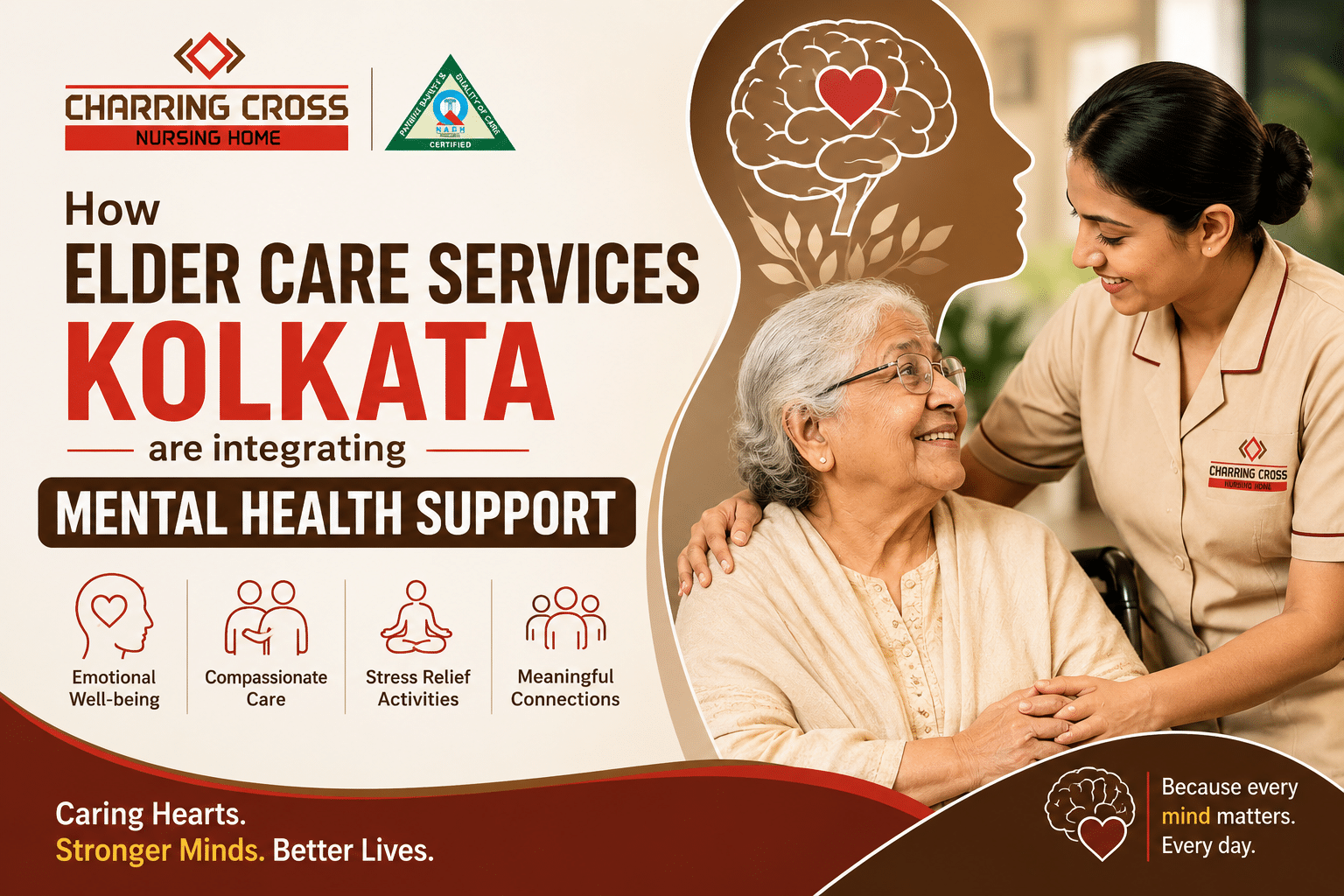
Walk into a place like Charring Cross Nursing Home and you won’t find a big sign saying “Mental Health Department.” That’s not how this works. The weave is much finer. It’s in the way a counsellor sits beside a new resident, not to rattle off a list of health questions, but to ask the kind of thing that actually matters, what music makes you close your eyes, what do you miss most about your old neighbourhood, have you been sleeping with the lamp on. It’s in the art session that shows up on a Wednesday not as a scheduled activity to tick off, but because putting colour on paper with unsteady hands can sometimes unlock a memory that words can’t find anymore.
The staff carry knowledge that never makes it onto a chart. They notice that Mr. Chatterjee’s whole face changes when someone brings up old Bengali cinema. They learn that Mrs. Banerjee will talk for half an hour if you only mention her marigolds. These little truths become gentle tools. When a resident retreats inward, the caregivers don’t automatically reach for a psychiatric referral. They try what’s worked before, maybe humming a particular song near her door, maybe a slow walk to the tiny shrine on the property, maybe just sitting alongside in silence, no pressure to fill the air with words.
One-on-one therapy happens, sure, but it’s rarely stiff. Often it’s a chat on a bench, watching squirrels chase each other. Group circles grow slowly, sometimes just from two or three ladies discovering they grew up a lane apart sixty years ago. The memory game will not feel like an exercise but a healthy teasing with friends. The gentle chair yoga and the evening walks are just not mere activities, it also decreases the sadness that settles in the bone.
The care giver who helps when bathing is trained differently. She can tell when a resident who flinched at her touch might be carrying something left over from a nightmare. The kitchen staff take note when someone who always asked for a second roti suddenly pushes the plate away untouched. Everyone is part of a quiet, watchful net. Mental health, in this kind of setting, stops being a clinical speciality and starts being a shared, instinctive kindness.
Where Family Slips Into the Picture
Something quietly remarkable happens when a care home takes emotional health seriously. The family begins to heal a little too. Anjali told me later that for months she’d been visiting her mother with a tight knot in her stomach, bracing for the flat responses, drowning in guilt she couldn’t name. But once the care team started drawing her mother back into tiny bits of light, a plant to water with another resident, an old song her father used to hum, the visits changed texture. Her mother started speaking again. Not in long speeches, maybe just a line or two. But real. And Anjali could feel the guilt loosening its grip, a guilt she hadn’t even let herself fully acknowledge.
The best homes now draw families in not just as guests but as allies. A counsellor might softly tell a daughter, “She lights up when you mention Durga Pujo. Tell me more about that time.” They guide relatives on how to be present without overwhelming, how to listen without jumping to fix. This way of working together is quietly becoming a marker of quality among elder care services Kolkata. It’s no longer enough to provide a clean bed and measured medication. Families want to know someone is watching over the emotional interior of the person they love, with real tenderness, not just duty.
The Quiet Proof That Any of This Matters
You can’t measure this kind of success with a lab value. You measure it in fleeting, precious moments. A woman who hadn’t smiled in weeks starts humming under her breath again. A man who refused to leave his room walks out to see the bougainvillaea in bloom and just stands there, breathing. Sleep deepens without a single change to sleeping pills.
It may feel insignificant for outside people, but for families , missing someone who is their whole world and still alive is totally a different feeling. And the medical side improves too when the dark fog lifts a little, people take their medications more willingly, eat with more interest, fight off the little infections that could turn serious. The mind and the body, it turns out, are one long, ongoing story. Ignore either half and the whole thing breaks.
Moving Forward Without Pretending It’s Simple
None of this is magic, and I don’t want to pretend it is. Integration takes time, more staff, a whole lot of patience, and a culture that values gentleness as much as efficiency. Not every facility does it. Families have to look closely. They have to ask the slightly awkward questions: What do you do when my mother is just sad and won’t explain why? Who notices if my father goes quiet? The answers tell you everything you need to know.
If you’re reading this and recognising your own story in Anjali’s, you are far from alone, and you haven’t failed. The very act of searching for a place that truly understands the depth of ageing is already a profound expression of love. Charring Cross Nursing Home is among those places that have been working, day in and day out, to weave mental health support into the ordinary rhythms of life, treating emotional well-being as something that deserves just as much attention as a pulse or a blood test. You can see how they approach it, and maybe begin a conversation, by visiting https://charringcross.com/. Sometimes the first step is simply permitting yourself to hope that things can become softer, warmer, and more human again. Because honestly, they can.